
What Is Bipolar Disorder?
Bipolar disorder is a chronic mood condition marked by intense episodes of mania (or hypomania) and depression — not ordinary mood swings, but disruptive shifts in energy, sleep, behavior, and thinking that can last weeks or months at a time.
It affects approximately 2.8% of U.S. adults and is one of the most frequently misdiagnosed conditions in psychiatry, often mistaken for unipolar depression. The average onset age is 25, and delayed diagnosis can set back effective treatment by years. According to the National Institute of Mental Health (NIMH), early and accurate diagnosis is critical to long-term stability.
At MindBrook Psychiatry in Tampa, Dr. Manita Shrestha specializes in identifying bipolar disorder across the full spectrum — including cases that have been previously missed or misdiagnosed.

Types of Bipolar Disorder
Understanding which type of bipolar disorder you have is essential — because treatment is not one-size-fits-all.
Bipolar I Disorder involves at least one full manic episode lasting seven or more days, often severe enough to require hospitalization. Manic symptoms include drastically reduced sleep, grandiosity, racing thoughts, and reckless behavior.
Bipolar II Disorder is defined by hypomanic episodes — a milder mood elevation — alongside major depressive episodes. Many patients describe hypomanic periods as actually feeling productive or energized, which is why Bipolar II is frequently underreported. Women are more commonly diagnosed with Bipolar II and are more prone to rapid cycling, often influenced by hormonal changes, PMDD, or peripartum mood shifts.
Cyclothymic Disorder involves chronic mood instability — fluctuating hypomanic and depressive symptoms over at least two years — that doesn’t meet the full criteria for either. Without treatment, cyclothymia can progress to Bipolar I or II.
Rapid Cycling means four or more mood episodes within a 12-month period, more common in women and particularly challenging to stabilize.
Mixed Features occur when mania and depression are present simultaneously — a person may feel energized yet deeply hopeless. Mixed episodes carry a heightened risk of self-harm and require urgent psychiatric attention.
Early Warning Signs of Bipolar Disorder in Adults
Recognizing bipolar disorder early — before a full episode takes hold — can be life-changing. Common early warning signs include:
- Sleep changes — needing far less sleep than usual without feeling tired, or sleeping excessively for days
- Sudden energy shifts — unusual bursts of productivity followed by profound fatigue or hopelessness
- Irritability — increased agitation or short-temperedness that seems out of character
- Grandiosity — an inflated sense of ability or identity during elevated periods
- Risky behavior — impulsive decisions around money, relationships, or substances
- Racing thoughts at night — inability to quiet the mind at bedtime
If you recognize these patterns in yourself or a loved one, a comprehensive psychiatric evaluation in Tampa is the right next step. Early intervention is one of the strongest predictors of long-term stability.
How Is Bipolar Disorder Diagnosed?
Bipolar disorder cannot be diagnosed through a blood test or brain scan. It requires a thorough clinical interview by a qualified psychiatric provider trained to identify nuances across the bipolar spectrum.
At MindBrook, Dr. Manita Shrestha conducts a comprehensive psychiatric evaluation that includes:
- A detailed psychiatric and mood history (including past episodes the patient may not have recognized as manic)
- Family history review — bipolar disorder has a strong genetic component
- Screening for co-occurring conditions such as PTSD, ADHD, OCD, and anxiety
- Assessment of functional impact on work, relationships, and daily life
Many MindBrook patients arrive having been previously diagnosed with depression or anxiety — and leave with a diagnosis that finally makes sense of years of confusing symptoms.
Bipolar disorder vs. unipolar depression: This distinction matters clinically. Antidepressants — the standard first-line treatment for unipolar depression — can trigger mania or rapid cycling in bipolar patients if given without a mood stabilizer. A proper diagnosis before any medication is prescribed is essential.
Bipolar Disorder Treatment in Tampa, FL
Effective bipolar disorder treatment is not a single prescription. It is a personalized, multimodal plan combining medication management, psychotherapy, lifestyle support, and ongoing monitoring.
Medication Management
Mood-stabilizing medications form the cornerstone of most bipolar treatment plans. Dr. Shrestha commonly uses:
- Lithium — the gold standard for both manic and depressive episodes and long-term relapse prevention
- Valproate (Depakote) — particularly effective for rapid cycling and mixed episodes
- Lamotrigine (Lamictal) — especially effective for the depressive phase, frequently used in Bipolar II
- Atypical antipsychotics — including quetiapine, aripiprazole, and lurasidone
Every medication plan is carefully titrated and monitored at each follow-up visit, with proactive side-effect management — because long-term adherence is one of the most critical factors in preventing relapse.
GeneSight Pharmacogenomic Testing — Precision Psychiatry
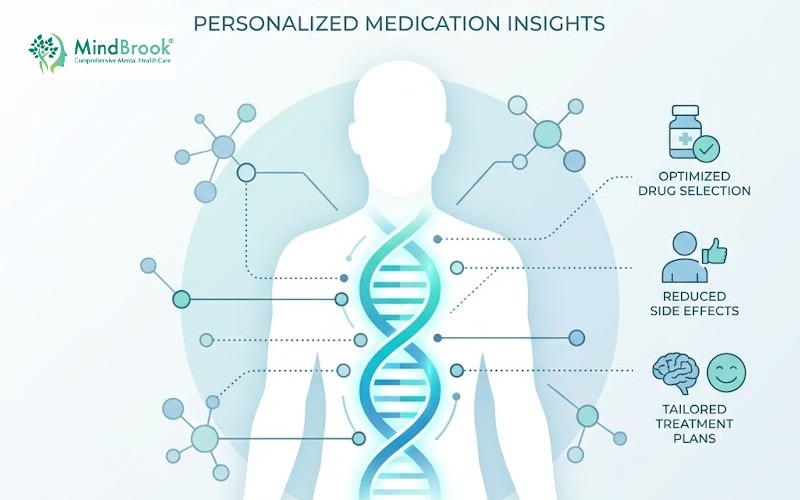
One of MindBrook’s most powerful differentiators is GeneSight psychotropic testing — a DNA-based test that analyzes how your body metabolizes psychiatric medications.
If you’ve experienced the trial-and-error medication approach common in bipolar treatment, GeneSight changes that entirely. By analyzing key genes (CYP2D6, CYP2C19), the test generates a personalized medication report categorizing drugs into:
- 🟢 Green — use as directed; standard genetic response
- 🟡 Yellow — use with caution; genetic factors may affect efficacy
- 🔴 Red — use with increased caution; genetic profile suggests potential issues
This is precision psychiatry — using your unique genetic blueprint to guide medication selection. GeneSight testing is available at MindBrook in Tampa as part of any evaluation or follow-up visit.
Psychotherapy
Medication stabilizes mood. Therapy builds the skills to maintain it. Evidence-based therapies used or referred at MindBrook include:
- CBT for bipolar disorder — restructures thought patterns that trigger or worsen episodes
- Interpersonal and Social Rhythm Therapy (IPSRT) — stabilizes daily routines (sleep, meals, social patterns) to reduce environmental triggers
- Psychoeducation — helps patients and families recognize warning signs and build crisis plans
- DBT — for patients with emotional dysregulation, impulsivity, or self-harm patterns
Relapse Prevention & Long-Term Management
Bipolar disorder is lifelong — but living well with it is absolutely achievable. Dr. Shrestha works with each patient to build a personalized relapse prevention plan, including identifying early warning signs, sleep hygiene strategies, stress management, and regular psychiatric follow-up appointments in-person or via telehealth.
Telehealth Psychiatry Across Florida

MindBrook’s HIPAA-compliant telepsychiatry platform allows patients across all of Florida to access expert bipolar care without leaving home. Research consistently shows that telehealth psychiatry produces outcomes comparable to in-person care for evaluation, medication management, and ongoing monitoring.
MindBrook’s telehealth services include virtual psychiatric evaluations, remote medication management, e-prescribing, and flexible follow-up scheduling — weekly, biweekly, or monthly as needed.
Serving: Tampa, Brandon, Riverview, Wesley Chapel, South Tampa, St. Petersburg, Clearwater, and all of Florida via telehealth.
Wondering if virtual care is right for you?
Insurance & Pricing
Under the Mental Health Parity and Addiction Equity Act, insurance plans are legally required to cover psychiatric services at the same level as medical care.
MindBrook accepts: Oscar Health · United Healthcare / UMR · Cigna · Aetna · Medicare · TRICARE
Self-pay: Initial evaluation $250 · Follow-up visits $150
Take the First Step
Living with bipolar disorder doesn’t have to mean living in survival mode. With the right diagnosis, medication plan — including GeneSight testing — and therapeutic support, stable mood and quality of life are within reach.
MindBrook Psychiatry is accepting new patients in Tampa, FL.
📍 University Lakes Professional Park, 14505 Bruce B Downs Blvd, Tampa, FL 33613
📞 813-680-2207
💻 Telehealth available statewide — same-day appointments available
🩺 Insurance accepted: Oscar, United Healthcare, UMR, Cigna, Aetna, Medicare, TRICARE
Frequently Asked Questions
Persistent sleep changes, unusual energy bursts, elevated or irritable mood lasting several days, impulsive behavior, and cycling depressive episodes. If these patterns repeat and feel outside your control, a psychiatric evaluation is warranted.
Bipolar I requires at least one full manic episode, which may include psychosis. Bipolar II involves hypomanic episodes — milder mood elevation — alongside major depressive episodes. Both require professional treatment.
For most patients with Bipolar I or II, medication is necessary. Mood stabilizers reduce episode frequency in ways therapy alone cannot. Medication works best combined with psychotherapy, lifestyle management, and regular psychiatric monitoring.
Common triggers include sleep disruption, major life stressors, substance use, seasonal changes, and for women, hormonal fluctuations tied to menstrual cycles, pregnancy, or perimenopause.
Yes. Multiple studies confirm that telepsychiatry produces comparable outcomes to in-person care. MindBrook’s HIPAA-compliant platform makes expert bipolar care accessible from anywhere in Florida.
PTSD is a mental health condition triggered by trauma, leaving the brain and body stuck in a prolonged stress response after danger has passed. Therapy helps.
Looking for trusted home care services in Sydney? GK Home Care offers NDIS-registered nursing & personal care. Call (02) 9064 4044 for a free consultation.
This content is written for educational purposes by Dr. Manita Shrestha, DNP, PMHNP-BC, at MindBrook Psychiatry (Everest Wellness & Behavioral Services LLC), Tampa, Florida. It is not a substitute for a personalized psychiatric evaluation. If you are in crisis or experiencing thoughts of self-harm, please call 988 (Suicide & Crisis Lifeline) or go to your nearest emergency room immediately.